Quantum Computers: The Future of Computing Explained


When you hear the term quantum computer, you might imagine a glowing machine from a sci-fi movie. But quantum computers are very real — and they could completely change the way we solve problems, process data, and even understand the universe.
To appreciate why they’re such a big deal, we first need to understand how regular (classical) computers work, and then see where quantum computers break the rules.
What is Quantum Internet for Those Who Are Curious?
How Regular Computers Work

Your laptop, phone, or even the most powerful supercomputer today operates on the same basic principle: bits.
A bit can be either a 0 or a 1. Every image you see, song you play, or program you run is broken down into billions of these 0s and 1s, which are processed through electrical circuits.
Classical computers are incredibly fast and powerful by today’s standards, but they have one key limitation:
They can only process one state of a bit at a time — either 0 or 1, never both.
The Quantum Leap — What Makes Quantum Computers Different

Quantum computers replace bits with qubits.
Thanks to the strange rules of quantum mechanics, a qubit can be:
01- Or both at the same time
This ability is called superposition.
It’s like flipping a coin — while it’s in the air, it’s both heads and tails. Only when you catch it does it “decide” which side it’s on.


But that’s not all. Qubits can also be entangled — meaning the state of one qubit can instantly affect another, no matter how far apart they are. This is what Einstein famously called “spooky action at a distance.”
Why This Changes Everything

Because qubits can represent multiple states at once, quantum computers can explore many solutions to a problem simultaneously.
A regular computer might have to check each possible solution one-by-one, but a quantum computer can check millions — or even billions — at the same time.
Example:
In 2019, Google announced that its quantum computer solved a specific mathematical problem in 200 seconds that would have taken the fastest classical supercomputer over 10,000 years.
The History of Quantum Computing

- 1980s: Physicist Richard Feynman suggested that quantum mechanics could be used to simulate systems that classical computers struggle with. This idea planted the seed for quantum computing.
- 1990s: Early theoretical models showed that quantum computers could crack certain encryption systems far faster than classical ones.
- 2001: IBM and Stanford created a simple quantum computer that could perform basic calculations.
- 2010s: Tech giants like Google, IBM, and Microsoft started building more advanced prototypes.
- 2019: Google’s Sycamore processor achieved “quantum supremacy” — solving a problem far beyond the reach of classical supercomputers.
- Today: Quantum computers are still in the experimental stage, but they’re improving rapidly.
Quantum vs. Classical — Key Differences
| Feature | Classical Computer | Quantum Computer |
|---|---|---|
| Data Unit | Bit (0 or 1) | Qubit (0, 1, or both at once) |
| Processing | Sequential | Parallel (many possibilities at once) |
| Best At | Everyday tasks, general computing | Complex simulations, cryptography, optimization |
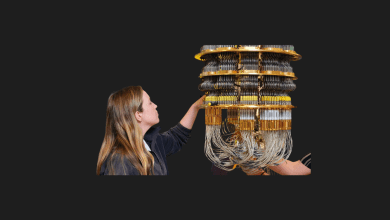
| Physical Build | Silicon chips | Special systems that require extreme cooling (near absolute zero) |
| Maturity | Fully developed and widely available | Still experimental and expensive |
Where Quantum Computers Could Change the World

- Medicine — Simulating molecules to discover new drugs faster.
- Climate Science — Modeling global weather patterns in unmatched detail.
- Finance — Solving complex risk and investment problems instantly.
- Cybersecurity — Breaking and building encryption methods.
- Artificial Intelligence — Training AI models in a fraction of the time.
The Challenges Ahead

- Error Rates: Qubits are fragile and easily disturbed by their environment.
- Cost: Quantum machines are extremely expensive to build and maintain.
- Accessibility: We’re still years away from having quantum computers in homes or offices.
Conclusion — The Future Is Quantum

Quantum computers aren’t here to replace your laptop. Instead, they’re being designed to solve problems that classical computers can’t — problems so complex that they’d take thousands of years to finish.
We’re still in the early days, but the potential is massive. If the 20th century was the era of classical computing, the 21st could be remembered as the age of quantum.
You Might Also Like;